

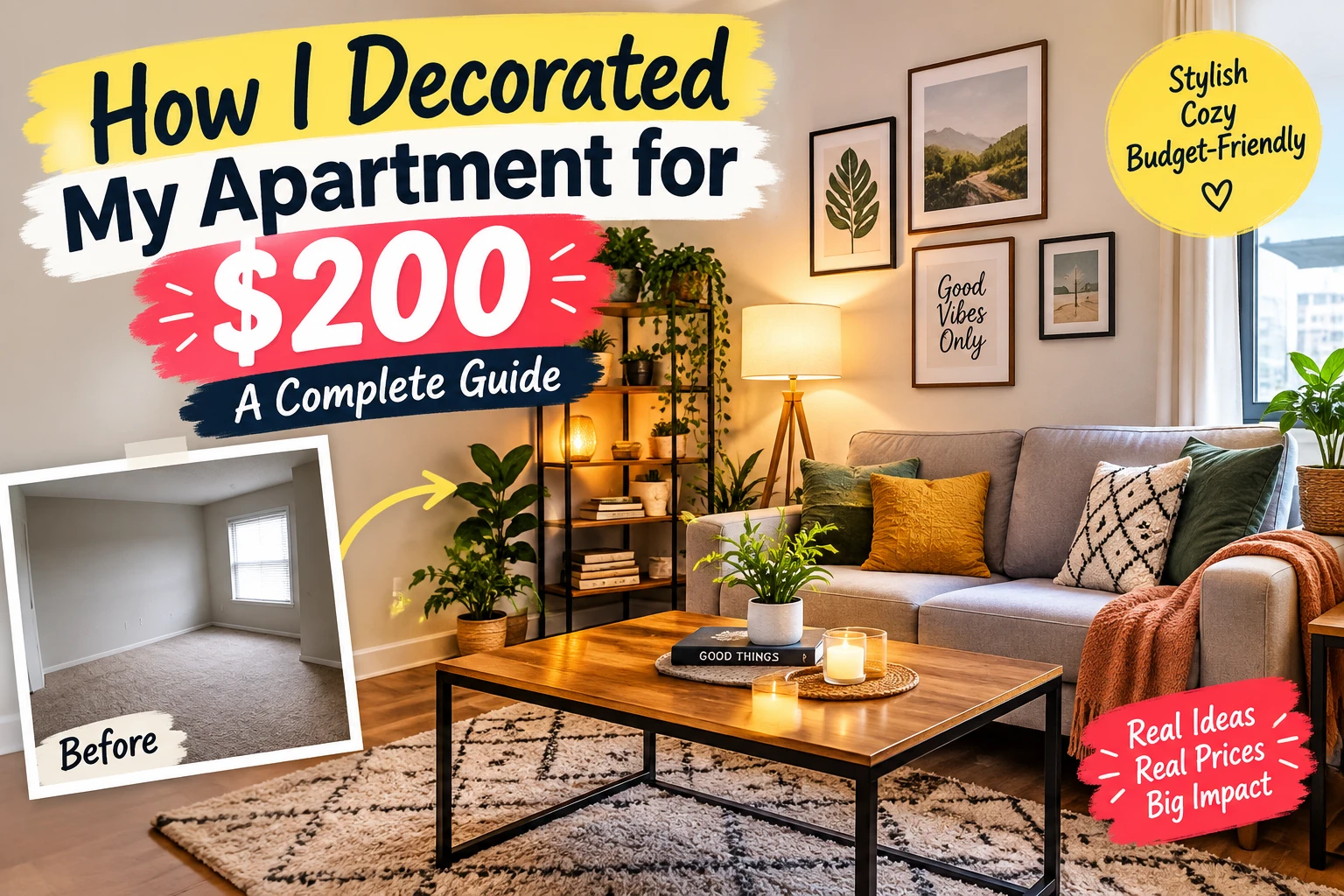
Most people assume that a well-decorated apartment requires a substantial budget, a professional designer, and months of planning.
I believed the same until I set myself a deliberate challenge: to decorate my entire apartment for $200 or less, without breaking my lease, without sacrificing quality, and without relying on a single piece of overpriced furniture.
The result exceeded my expectations. A space that once felt bare, impersonal, and uninspiring became warm, layered, and unmistakably mine.
This guide documents every decision, every purchase, and every principle behind the transformation, so that you can replicate it in your own home, whatever its size or style.
Whether you are a first-time renter, a student, a young professional, or simply someone who wants a better home without financial strain, this article gives you a proven framework for budget apartment decorating that works.
The $200 Budget Breakdown at a Glance
Before examining each step, here is the exact allocation of funds. A fixed budget with defined categories is the single most effective discipline in low-cost decorating, because it prevents impulse purchases and forces every dollar to earn its place.
| Category | Budget | Purpose |
|---|---|---|
| Wall treatments and paint | $40 | Create visual impact and colour cohesion |
| Lighting | $30 | Establish atmosphere and warmth |
| Textiles (throw, pillows, curtains) | $35 | Add texture, comfort, and softness |
| Secondhand furniture and accents | $40 | Fill functional gaps with character |
| Art and gallery wall | $20 | Introduce personality |
| Plants and greenery | $15 | Bring life and freshness |
| Organization and small hardware | $10 | Reduce clutter and improve function |
| Contingency reserve | $10 | Cover unexpected costs |
| Total | $200 |
Prices vary by region and by what you find secondhand, so treat these figures as a realistic benchmark rather than a rigid rule.
Why Most People Overspend When Decorating an Apartment
Understanding the common causes of overspending is the first step toward avoiding them. In my experience, budgets fail for four predictable reasons:
- Buying without a plan. Impulse purchases rarely coordinate with one another, which leads to duplication and waste.
- Prioritizing furniture over atmosphere. A new sofa costs hundreds of dollars, whereas lighting, textiles, and colour can change a room’s mood for a fraction of the price.
- Following trends instead of preferences. Trend-driven décor dates quickly and is expensive to replace.
- Ignoring what is already owned. Most households contain items that, once repositioned or repurposed, serve as effective décor.
The strategy that follows addresses each of these problems directly.
Step 1: Define Your Style and Audit What You Already Own (Cost: $0)
The most valuable stage of the entire project cost nothing. Before spending anything, I completed two tasks.
Choose a Cohesive Style Direction
A clear aesthetic direction is what separates a curated home from a cluttered one. I selected a warm, minimalist style built on three principles:
- A limited colour palette: soft white, warm beige, muted sage green, and natural wood tones
- A preference for natural textures such as linen, cotton, wicker, and wood
- A commitment to fewer, better-chosen items rather than many mismatched ones
You may prefer bohemian, modern, industrial, or Scandinavian styles. The specific choice matters less than the consistency of the choice. A consistent palette makes even inexpensive items appear intentional.
Audit Your Existing Belongings
I then walked through each room and asked three questions about every item:
- Does it suit the chosen style?
- Can it be moved to a better location?
- Can it be repurposed (a jar as a vase, a crate as a shelf, a scarf as a wall hanging)?
This audit eliminated roughly a third of my planned purchases and provided the foundation on which the rest of the budget was built.
Step 2: Transform the Walls Without Losing Your Deposit (Cost: $40)
Walls occupy the largest visual area in any room, which makes them the highest-impact investment in a decorating budget. Renters, however, face restrictions. The following methods are both effective and lease-friendly.
Peel-and-Stick Wallpaper for an Accent Wall
A single accent wall in a removable, peel-and-stick pattern immediately creates a focal point. I applied a textured sage-green product behind the bed. It required no adhesive residue, no tools, and no professional installation, and it can be removed at the end of the tenancy.
Removable Paint Alternatives and Sample Pots
Where the lease permits painting, sample-size paint pots are inexpensive and sufficient for smaller surfaces such as a door, a bookshelf, or a section of wall. If painting is prohibited, fabric panels or large canvases in your chosen palette can achieve a similar effect.
Adhesive Hooks and Strips
Damage-free hanging solutions allow you to display art, mirrors, and lightweight shelves without a single nail hole. This small purchase protects your security deposit and gives you complete freedom in arranging your walls.
Step 3: Use Lighting to Create Atmosphere (Cost: $30)
If there is one principle that separates professional interiors from amateur ones, it is lighting. Overhead lighting in most apartments is harsh, flat, and unflattering. Replacing it, or at least supplementing it, transforms the room instantly.
Layer Your Light Sources
Professional designers rely on three layers of light:
- Ambient lighting: the general illumination of the room
- Task lighting: focused light for reading, working, or cooking
- Accent lighting: decorative light that adds mood and highlights features
I spent my lighting budget on:
- Warm-white LED bulbs (2700K) to replace cold, bluish bulbs in existing lamps
- A secondhand table lamp found for a few dollars, paired with a new linen shade
- String lights draped along the bookshelf for soft accent illumination
The colour temperature of a bulb has a dramatic effect on how a room feels. Warm light makes spaces feel inviting and intimate, while cool light makes them feel clinical. This single change cost less than a takeaway meal and altered the entire character of the apartment.
Step 4: Add Texture and Comfort with Textiles (Cost: $35)
Textiles are the most cost-effective way to add warmth and depth to a room. They soften hard surfaces, absorb sound, and introduce colour and pattern without permanent commitment.
Curtains
Replacing thin, builder-grade blinds with floor-length curtains makes ceilings appear taller and windows appear larger. The trick lies in mounting the rod higher and wider than the window frame. Simple cotton or linen-blend panels in a neutral shade work best, and they can often be found inexpensively at discount retailers or thrift shops.
Throw Pillows and Blankets
Rather than buying complete sets, I purchased pillow covers only, reusing existing inserts. This approach cuts the cost significantly. I combined three textures (linen, knit, and velvet) in a consistent colour family to create a layered, high-end look.
Rugs
A rug anchors a seating area and defines the space. If a new rug exceeds your budget, look for secondhand options, remnant carpet pieces, or affordable flat-weave designs. Even a modestly sized rug elevates a room noticeably.
Step 5: Shop Secondhand for Furniture and Accents (Cost: $40)
Buying new furniture is the fastest way to exhaust a small budget. Secondhand shopping is not merely economical; it often yields better construction, more interesting design, and more character than mass-produced alternatives.
Where to Find Quality Secondhand Items
- Thrift stores and charity shops, which are excellent for lamps, mirrors, frames, and baskets
- Online marketplaces such as Facebook Marketplace, Craigslist, OLX, and local buy-and-sell groups
- Estate sales and garage sales, where solid wood pieces are often priced to sell quickly
- Neighbourhood “free” groups, where usable furniture is routinely given away
What I Bought
With $40, I acquired a solid wood side table, a wicker basket for blanket storage, and a vintage mirror with an ornate frame. A light sanding and a coat of clear finish restored the table to a condition that appeared far more expensive than it was.
Negotiation Principles
- Visit listings early in the week and in the late afternoon, when sellers are more flexible
- Bundle items from the same seller to request a discount
- Be polite and specific; a reasonable offer is rarely refused
Step 6: Build a Gallery Wall on a Shoestring (Cost: $20)
Art gives a home its personality. Blank walls read as unfinished, yet original art is often prohibitively expensive. A gallery wall solves this problem affordably.
Low-Cost Sources for Art
- Free printable art from public-domain museum collections
- Personal photographs printed at a local shop for a few cents each
- Thrifted frames, refreshed with a coat of spray paint in a unified colour
- Fabric, maps, or pressed botanicals framed as textural pieces
Arrangement Guidelines
Lay the arrangement on the floor first, using paper templates to plan the layout. Maintain consistent spacing (approximately two inches) between frames, and centre the completed grouping at eye level, roughly 57 inches from the floor to the middle of the arrangement. These simple rules give even mismatched frames a deliberate, gallery-quality appearance.
Step 7: Bring the Space to Life with Plants (Cost: $15)
Plants are among the most affordable and effective decorative tools available. They introduce colour, improve the sense of freshness, and soften the geometry of a room.
Choose low-maintenance varieties that tolerate typical apartment conditions:
- Pothos, which thrives in low to medium light and is difficult to kill
- Snake plant, which tolerates neglect and irregular watering
- ZZ plant, which handles low light exceptionally well
- Spider plant, which propagates easily so that one purchase becomes several
Propagation deserves particular mention. Cuttings from friends or a single mature plant can populate an entire apartment for almost nothing. Pair plants with thrifted ceramics or repurposed jars to avoid the cost of new planters.
Step 8: Organize to Make the Space Feel Larger (Cost: $10)
Décor cannot compensate for clutter. Organization is decoration, because a tidy space always appears more expensive and more spacious than a crowded one.
With the final $10, I purchased:
- Adhesive hooks for keys, bags, and towels
- Small baskets and trays to group loose items
- Drawer dividers to keep everyday objects contained
Grouping items on trays, keeping surfaces at least half clear, and assigning every object a home make a room feel calmer and more deliberate.
Room-by-Room Application
The Living Room
Focus on lighting, a rug, and layered textiles. A single coordinated colour scheme across cushions, throws, and art makes the space feel unified even if the furniture is inexpensive or borrowed.
The Bedroom
Prioritize the bed as the focal point. Quality bedding in a neutral palette, an accent wall behind the headboard, and warm bedside lighting create a hotel-like retreat at minimal cost.
The Kitchen
Small changes make a difference: new cabinet pulls, a plant on the windowsill, a decorative tray for oils and spices, and removable backsplash tiles in place of dated surfaces.
The Bathroom
Replace tired accessories with a coordinated set, add a small plant, hang a fresh shower curtain, and introduce a folded stack of neutral towels for a spa-like effect.
The Entryway
A hook rail, a mirror, and a small tray create a functional and welcoming first impression, even in the tightest hallway.
Common Mistakes to Avoid When Decorating on a Budget
- Purchasing everything at once. Buy in stages and live in the space; you will learn what it genuinely needs.
- Choosing cheap items that look cheap. Prioritize material and finish over quantity. One good piece is better than three poor ones.
- Ignoring scale. Oversized furniture overwhelms small apartments, and tiny décor disappears in large rooms.
- Mixing too many styles or colours. Restrict yourself to a defined palette of three to four tones.
- Neglecting the lease. Confirm what modifications are permitted before you begin, to protect your deposit.
- Skipping the finishing touches. Steamed curtains, straightened frames, and clean surfaces matter as much as the purchases themselves.
Key Principles That Made the $200 Budget Work
- Plan before you purchase. A written list and budget prevent waste.
- Invest in atmosphere, not furniture. Light, colour, and texture deliver the greatest return.
- Buy secondhand first. New items should be the exception rather than the rule.
- Stay within a single palette. Cohesion is the hallmark of good design.
- Choose removable solutions. Renter-friendly methods protect both your deposit and your flexibility.
- Edit ruthlessly. Fewer, better-chosen items always outperform abundance.
Frequently Asked Questions
Is it really possible to decorate an entire apartment for $200?
Yes, provided you set clear priorities, shop secondhand, use what you already own, and focus on high-impact, low-cost categories such as lighting, textiles, and wall art. The amount will not furnish an empty apartment from scratch, but it is enough to transform a space that already has basic furniture.
What is the best first purchase when decorating on a budget?
Lighting typically offers the greatest return. Warm-white bulbs and a single lamp can change how the whole room feels for very little money.
How can renters decorate without damaging the walls?
Use adhesive hooks, peel-and-stick wallpaper, leaning mirrors, freestanding shelving, and fabric hangings. All of these can be installed and removed cleanly.
Where can I find the cheapest quality décor?
Thrift stores, online marketplaces, estate sales, and community giveaway groups consistently offer the best value. Discount retailers are also worthwhile for basics such as curtains and pillow covers.
How do I make a small apartment look bigger?
Use light, cohesive colours, hang curtains high, add mirrors opposite windows, keep surfaces uncluttered, and choose furniture in proportion to the space.
How long does a budget apartment makeover take?
Most people can complete the essential changes in one to three weekends. Sourcing secondhand items may extend the timeline, but patience usually results in better finds at lower prices.
Final Thoughts: Good Design Is Not a Question of Budget
This project confirmed something that professional designers have long understood: good design depends on decisions, not expenditure.
A clear vision, a disciplined budget, and a willingness to look beyond retail shelves can produce an apartment that feels considered, comfortable, and personal.
Two hundred dollars did not buy luxury. It bought intention: a deliberate palette, warm lighting, layered textures, meaningful art, and living greenery. Those elements, applied consistently, outperform expensive furniture in a disorganized room.
Begin with a single step: define your style, audit your belongings, and write your budget. Then allow the space to evolve gradually, one thoughtful purchase at a time. Your apartment does not need to be expensive to feel exceptional.