

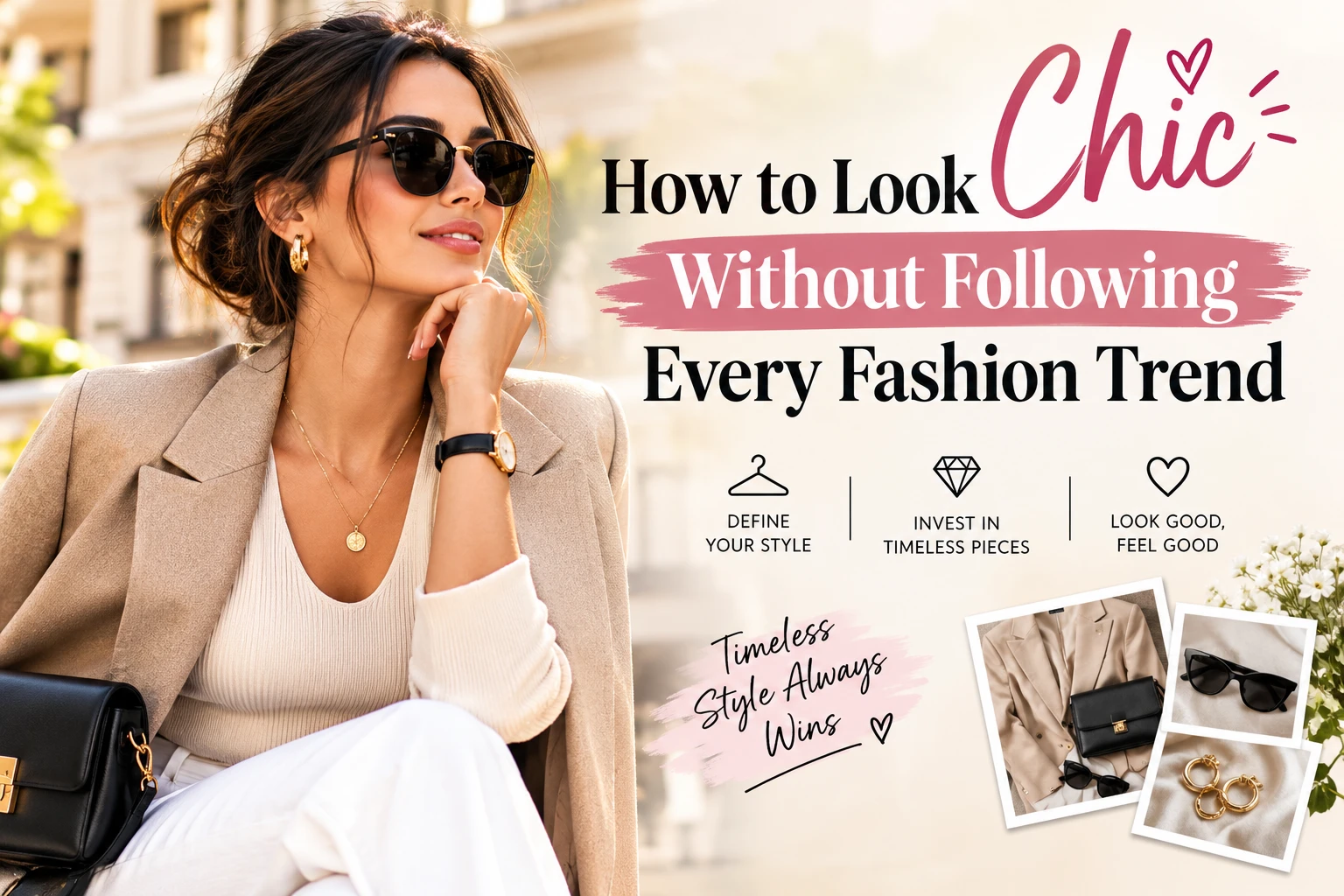
There is a common misconception that looking chic requires an encyclopedic knowledge of every micro-trend circulating on social media — the latest “it” bag, the season’s must-have color, or whatever silhouette influencers are currently championing. In reality, true chic style has almost nothing to do with trend-chasing and everything to do with intentionality, proportion, and self-knowledge.
Chic is not about owning the most clothes or the newest clothes. It is about owning the right clothes — pieces that fit impeccably, flatter your body, reflect your personality, and work together as a cohesive system rather than a chaotic collection of impulse purchases.
This guide will walk you through exactly how to cultivate that elusive, effortless elegance without ever feeling like you’re on a fashion treadmill, sprinting to keep up with trends that will be irrelevant in six months anyway.
1. Understand the Difference Between Style and Fashion
Fashion is temporary. Style is permanent.
Fashion refers to what is popular right now — it is dictated by designers, marketing campaigns, and cultural moments, and it changes on a predictable cycle. Style, on the other hand, is a personal signature. It’s the way you interpret clothing to express who you are, regardless of what’s trending.
Women (and men) who are remembered for their iconic style — think Audrey Hepburn, Grace Kelly, or more contemporary icons like Meghan Markle in her pre-royal styling days — were rarely, if ever, defined by trends. They were defined by consistency, restraint, and a deep understanding of what worked for their body and lifestyle.
The first step toward looking chic without following every trend is a mental shift: stop asking “What’s in style right now?” and start asking “What is in style for me?“
2. Build a Capsule Wardrobe Rooted in Quality, Not Quantity
A cluttered closet is the enemy of chic dressing. When you own too many pieces — many of them trend-driven and rarely worn — you create decision fatigue and dilute your personal aesthetic.
Instead, build what stylists call a capsule wardrobe: a curated collection of interchangeable, high-quality pieces that can be mixed and matched to create dozens of outfits.
Core capsule wardrobe essentials include:
- A well-tailored blazer in a neutral shade (navy, black, camel, or grey)
- Straight-leg or wide-leg trousers that skim rather than cling
- A crisp white button-down shirt — arguably the single most versatile garment in existence
- A classic trench coat
- Dark, well-fitted denim with no distressing or trendy washes
- A little black dress cut in a flattering, timeless silhouette
- Neutral leather shoes — a loafer, a simple pump, and a clean sneaker
- A structured handbag in a neutral, durable leather
Notice that none of these items are “trendy.” They are foundational. When your wardrobe foundation is strong, you never feel pressure to buy the latest micro-trend because your outfits already feel complete, polished, and intentional.
3. Master the Art of Fit Over Everything Else
If there is one non-negotiable rule in dressing chic, it is this: fit is everything.
An inexpensive garment that is tailored to your body will always look more expensive and more elegant than a designer piece that fits poorly. Chic women understand that tailoring is an investment, not an indulgence.
Fit-focused habits to adopt:
- Take every new garment to a tailor for minor adjustments — hemming, waist take-ins, sleeve shortening.
- Pay attention to shoulder seams; they should sit exactly at the edge of your shoulder.
- Avoid anything that pulls, gapes, or bunches — these are the telltale signs of an ill-fitting garment.
- Choose trousers that hit the correct point on your shoe, whether cropped, full-length, or floor-grazing.
A perfectly tailored outfit in the simplest fabric will always outshine a trendy outfit that doesn’t fit correctly. This is one of the most overlooked secrets of effortless elegance.
4. Choose a Signature Color Palette
Chic dressing is inherently cohesive. One of the fastest ways to look put-together without following trends is to commit to a personal color palette — a curated set of 4 to 6 colors that flatter your skin tone and complement one another.
Why a signature palette works:
- It eliminates impulse buys of trendy colors that don’t suit you.
- It ensures everything in your closet works together, reducing “nothing to wear” mornings.
- It creates a recognizable, intentional aesthetic — which reads as confidence.
Popular chic palettes include:
- Monochromatic neutrals: black, white, grey, camel, navy
- Warm earth tones: rust, olive, cream, chocolate brown
- Cool minimalism: charcoal, ice blue, stone, black
Once your palette is established, shopping becomes dramatically easier, and your outfits will always look curated — never chaotic.
5. Elevate Basics With Texture, Not Trends
A common mistake is assuming that “trend-free” dressing means boring dressing. This could not be further from the truth. The secret weapon of chic style is texture and fabric quality, not trend-driven prints or logos.
Ways to add visual interest without chasing trends:
- Mix matte and shiny fabrics in the same outfit (e.g., a silk blouse under a wool blazer).
- Layer different textures in the same color family — a ribbed knit with tailored wool trousers.
- Invest in natural fibers like cashmere, silk, linen, and fine cotton, which drape and age better than synthetic trend-driven fabrics.
- Use accessories — a structured bag, a subtle gold cuff, a silk scarf — as your “statement” element instead of loud trend pieces.
This approach keeps your look feeling rich and dynamic while remaining entirely trend-independent.
6. Practice Restraint: The Power of Editing
One of the most underrated style skills is knowing what to leave off. Chic women are ruthless editors of their own outfits. Before walking out the door, they ask: “What one thing can I remove to make this look more refined?”
Coco Chanel’s famous advice — to remove one accessory before leaving the house — remains one of the most timeless style principles ever articulated.
Over-accessorizing, over-layering, and over-styling are the fastest ways to make an outfit feel dated or try-hard, regardless of how “on-trend” the individual pieces are.
Editing checklist before you leave the house:
- Remove one accessory (jewelry, belt, or scarf).
- Simplify your color story — no more than three colors per outfit, ideally.
- Ask if every piece is earning its place, or if it’s just “noise.”
7. Invest in a Few Statement Pieces That Reflect You
While the foundation of a chic wardrobe should be timeless and neutral, that doesn’t mean your style should lack personality. The key is choosing statement pieces intentionally, not because they are trending, but because they genuinely resonate with your taste.
Perhaps it’s a bold red coat you’ll wear for a decade. Perhaps it’s vintage jewelry passed down from a grandparent. Perhaps it’s an architectural handbag that feels like you, regardless of what’s “in” this season.
These pieces should be chosen slowly, deliberately, and with the expectation that you’ll wear them for years — not one Instagram post.
8. Groom, Posture, and Confidence: The Invisible Ingredients of Chic
No conversation about looking chic is complete without acknowledging that clothing is only part of the equation.
Some of the most elegant, chic individuals in the world wear remarkably simple clothing — the difference lies in how they carry themselves.
Non-clothing elements of chic style:
- Polished grooming: well-maintained hair, skin, and nails signal care and intentionality.
- Good posture: standing tall instantly elevates any outfit, however simple.
- Unhurried movement: chic people rarely rush or fidget; they move with calm confidence.
- Minimal, well-applied makeup: a “your skin but better” approach rather than heavy, trend-driven looks.
These intangible qualities often matter more than the clothes themselves. A woman in jeans and a white shirt with excellent posture and quiet confidence will always look more chic than someone dressed head-to-toe in trending pieces but lacking self-assurance.
9. Shop Slowly and Intentionally
Trend-driven fashion thrives on urgency — limited drops, flash sales, “get it before it’s gone” messaging. Chic dressing, by contrast, thrives on patience.
Adopt a slow-shopping philosophy:
- Wait 48 hours before purchasing anything that isn’t a true wardrobe staple.
- Ask: “Will I still love this in five years?”
- Shop with a written list of gaps in your wardrobe rather than browsing aimlessly.
- Prioritize cost-per-wear over upfront price — a $200 coat worn 200 times is more valuable than a $40 trend piece worn twice.
This approach not only saves money but ensures every piece in your closet is genuinely chosen, not impulsively acquired.
10. Let Your Personal History Inform Your Style
Finally, the most enduring style icons draw inspiration from their own lives — their culture, their travels, their family history — rather than from fleeting trend cycles. This is what makes their style feel authentic rather than derivative.
Consider incorporating:
- Family heirlooms or vintage pieces with sentimental value
- Cultural garments or techniques (embroidery, weaving styles) that connect to your heritage
- Colors or silhouettes that remind you of meaningful places or people
When your style tells a story, it becomes inherently timeless — because trends can be copied, but personal history cannot.
Conclusion: Chic Is Built, Not Bought
Looking chic without following every fashion trend is entirely achievable — and arguably more sustainable, more affordable, and more personally satisfying than chasing seasonal fads. It requires a shift in mindset from consumption to curation, from more to better, and from trendy to timeless.
By focusing on fit, quality, a signature color palette, thoughtful editing, and quiet confidence, you can build a wardrobe — and a presence — that feels effortlessly elegant in any decade. True chic style doesn’t ask, “What’s everyone wearing this season?” It asks, “What makes me feel most like myself, at my best?“
That question, answered honestly and consistently, is the real secret to timeless, trend-proof style.