

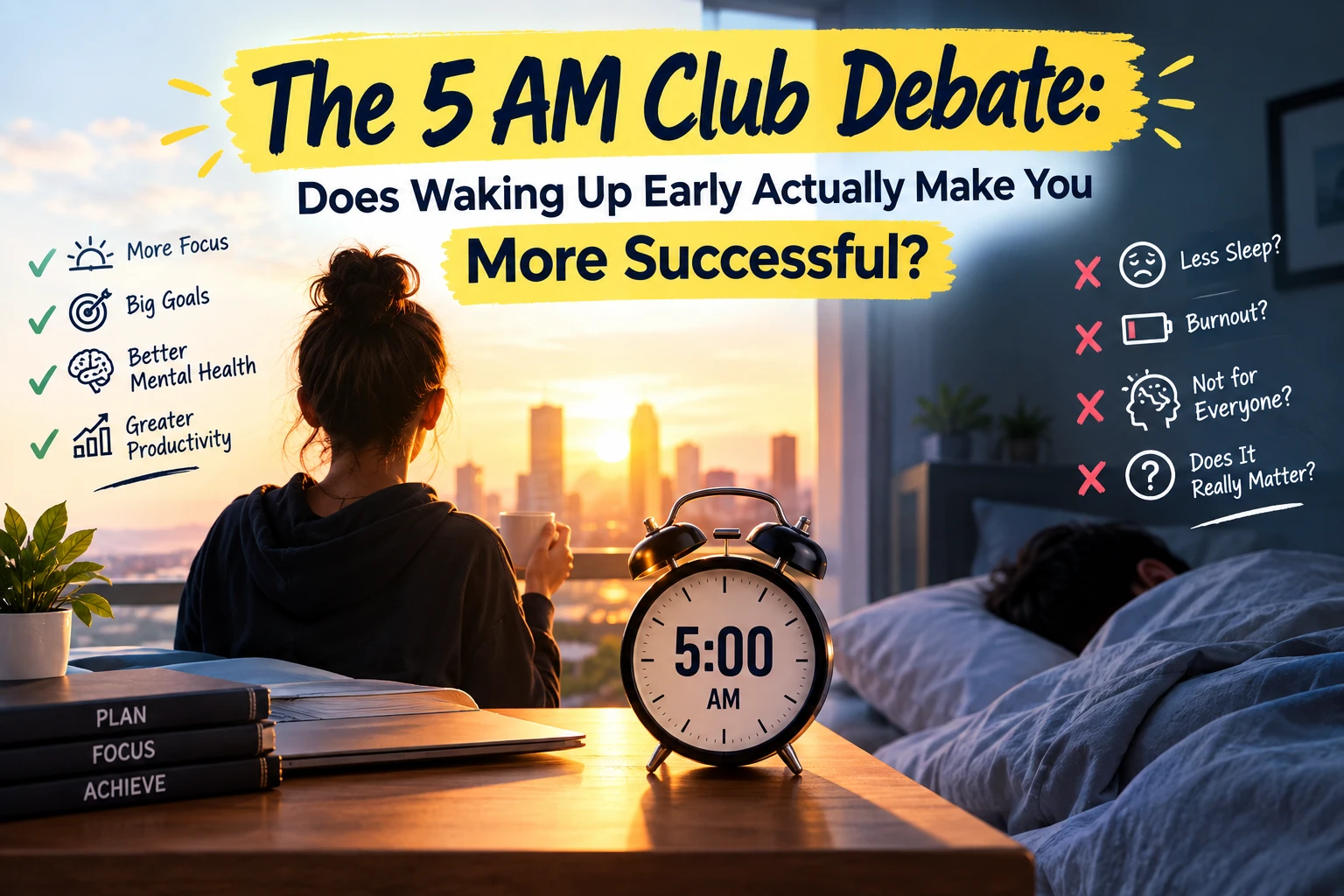
Somewhere between motivational Instagram reels and billionaire morning routines, the 5 AM Club became a cultural phenomenon.
Millions of people now set their alarms before sunrise, convinced that the secret to wealth, discipline, and self-mastery lies in those quiet, dark hours before the rest of the world wakes up.
But here’s the uncomfortable question nobody wants to ask out loud: does waking up at 5 AM actually make you more successful — or is it just a comforting ritual that feels productive?
In this article, we’re going to dig deeper than the surface-level hype. We’ll explore the real science behind early rising, the psychology of why the 5 AM Club feels so appealing, who it genuinely helps, who it doesn’t, and — most importantly — what actually separates high achievers from everyone else. Spoiler: it’s not the number on your alarm clock.
What Is the 5 AM Club, Really?
The concept was popularized by author Robin Sharma in his bestselling book The 5 AM Club, which introduced the idea of the “20/20/20 formula” — spending the first hour of your day in three 20-minute blocks dedicated to exercise, reflection, and learning.
The premise is simple and seductive: own your morning, elevate your life. Wake up before the world does, seize uninterrupted time for yourself, and you’ll unlock discipline, clarity, and productivity that spills into every other area of your life.
It’s a compelling story. And like most compelling stories, it contains real truth — wrapped inside a generalization that doesn’t apply to everyone equally.
The Real Science: What Chronobiology Actually Says
This is where most 5 AM Club advocates go quiet, because the science is more nuanced than the hashtags suggest.
1. Humans Have Different Chronotypes
Sleep researchers have identified that people fall along a spectrum of chronotypes — genetically influenced patterns that determine whether someone is naturally a “morning lark,” a “night owl,” or somewhere in between.
This isn’t a matter of willpower or laziness; it’s largely driven by your circadian rhythm, the internal biological clock that regulates hormone release, body temperature, and alertness.
For a natural morning lark, waking at 5 AM aligns perfectly with their biology — they’ll feel alert, focused, and energized. For a natural night owl, the same 5 AM alarm forces them into a state of chronic social jet lag, fighting their own biology every single day.
Over time, this mismatch is linked to increased fatigue, lower cognitive performance, and even long-term health risks.
The key takeaway: there is no universally “optimal” wake-up time. There is only the optimal wake-up time for your biology.
2. Sleep Quality Matters More Than Wake-Up Time
Here’s what the 5 AM Club doesn’t put on the book cover: waking up early with insufficient or poor-quality sleep is worse than waking up later with full, restorative sleep.
Sleep scientists consistently point to two things that matter far more than clock time:
- Total sleep duration — most adults need 7–9 hours per night for optimal cognitive and physical function.
- Sleep consistency — going to bed and waking up at the same time every day, regardless of what that time is, strengthens your circadian rhythm far more than an arbitrary early wake-up.
Sacrificing sleep to join the 5 AM Club doesn’t create discipline — it creates sleep debt, which impairs memory, decision-making, emotional regulation, and immune function. In other words, the very things you’re trying to optimize by waking up early are the things you damage when you don’t sleep enough to do it.
Why the 5 AM Club Feels So Effective (Even When It Isn’t the Real Reason)
If the science is this nuanced, why do so many successful people swear by early rising? The answer lies less in the hour itself and more in what early rising forces you to do.
It Creates Uninterrupted Time
Before 6 or 7 AM, most people aren’t emailing you, texting you, or scheduling meetings. This isn’t magic — it’s simply low-distraction time, and it happens to exist at that hour because the rest of the world is asleep. The same effect can be achieved late at night, or during any consistently protected block of time.
It Requires a Structured Routine
Committing to a 5 AM wake-up almost always comes bundled with other habits — exercise, journaling, reading, planning — because you need a reason to be up. It’s often the routine itself, not the wake-up time, that drives the results people credit to early rising.
It Signals Identity and Discipline
Psychologically, successfully sticking to a hard commitment (like a brutal early alarm) reinforces a self-image of discipline and control. This identity-based motivation genuinely does spill into other areas of life — not because of biology, but because of belief.
Who Genuinely Benefits From the 5 AM Club
To be fair to the concept, early rising does work exceptionally well for certain people and certain goals:
- Natural morning larks whose biology is already wired for early alertness
- Parents and caregivers who need quiet time before household responsibilities begin
- Entrepreneurs and executives whose only truly uninterrupted hours are before the workday floods their calendar
- People building a new habit who need a hard behavioral anchor to create consistency
- Those in fitness-focused routines, since morning exercise has been associated with easier long-term adherence for many people
If you fall into one of these categories, waking up early may genuinely be one of the better decisions you make.
Who the 5 AM Club Can Actively Hurt
On the other side, forcing a 5 AM routine can backfire for:
- Natural night owls, whose biology fights the early clock and leads to chronic fatigue
- Shift workers or irregular-schedule professionals, where consistency matters more than any specific hour
- People already sleep-deprived, who need more rest, not an earlier alarm
- Creative professionals who often report peak focus and idea generation later in the day
- Anyone sacrificing sleep hours to hit 5 AM rather than shifting their entire schedule earlier
For these groups, the 5 AM Club doesn’t build discipline — it builds burnout dressed up as productivity.
The Real Secret: It’s Not the Time, It’s the System
Here’s the honest, unglamorous truth that most productivity content avoids saying directly:
Success isn’t determined by what time you wake up. It’s determined by what you consistently do with the time you have.
The most successful people share a common trait — but it isn’t early rising. It’s protected, distraction-free time dedicated to their most important priorities, done consistently, day after day. For some people, that window is 5 AM. For others, it’s 11 PM. For others still, it’s a two-hour block carved out of a Tuesday afternoon.
What actually drives results is a combination of:
- Consistency — showing up for your goals every day, not just on motivated days
- Protected focus time — blocks free from notifications, meetings, and distractions
- Alignment with your biology — working with your natural energy patterns instead of against them
- Clear priorities — knowing exactly what deserves your best hours
- Sustainable habits — routines you can maintain for years, not just weeks
How to Build a Morning (or “Peak Hour”) Routine That Actually Works for You
Instead of blindly adopting someone else’s 5 AM formula, here’s a more effective, personalized approach:
Step 1: Identify Your Natural Energy Peak
Track your alertness for one to two weeks. Notice when you naturally feel sharpest — that’s your true “power hour,” regardless of what the clock says.
Step 2: Protect That Window Like a Meeting You Can’t Miss
Block it on your calendar. Turn off notifications. Treat it as non-negotiable — not because of the hour, but because of its value.
Step 3: Anchor It With a Simple Routine
Borrow the structure of the 5 AM Club — movement, reflection, focused learning — without forcing the specific hour. The formula works; the fixed clock time doesn’t have to.
Step 4: Prioritize Sleep Consistency Over Wake-Up Time
Pick a bedtime and wake-up time you can sustain for years, not just weeks. Consistency beats intensity every time.
Step 5: Review and Adjust Every Few Weeks
Your ideal routine will shift with your season of life, workload, and energy levels. Treat your schedule as a living system, not a fixed rulebook.
Frequently Asked Questions
Is waking up at 5 AM scientifically proven to increase productivity?
No single study proves that 5 AM specifically boosts productivity. What research does support is the value of consistent sleep schedules and protected, distraction-free focus time — which can happen at any hour that matches your biology.
Do successful people really wake up at 5 AM?
Some do, and many genuinely credit it with improving their focus and discipline. However, plenty of equally successful people are night owls who do their best work late at night. The common thread is a consistent, protected routine, not a specific hour.
Will joining the 5 AM Club make me more disciplined?
It can help build discipline through the achievement of a hard commitment, but the discipline comes from consistency and follow-through, not from the number 5 itself.
Is it unhealthy to force yourself to wake up early?
If it comes at the cost of your required sleep duration or fights against your natural chronotype, yes — it can lead to fatigue, reduced cognitive performance, and long-term health consequences.
What’s a better alternative to the 5 AM Club?
Identify your personal peak energy window, protect it consistently, and build a simple, repeatable routine around it — regardless of what time it falls at.
Final Verdict: Is the 5 AM Club Worth It?
The 5 AM Club isn’t a myth, but it isn’t a universal rule either. For the right person — a natural early riser with a schedule that allows for it — it can be a genuinely powerful tool for building focus, discipline, and momentum.
But for millions of others, blindly adopting a 5 AM alarm is trading quality sleep and natural energy alignment for a routine that looks impressive on paper but quietly erodes performance over time.
The real secret was never the clock. It’s the commitment, the consistency, and the courage to build a system that works with your life — not against it.
Wake up at 5 AM if it serves you. But if it doesn’t, don’t mistake exhaustion for discipline. True productivity isn’t about beating the sunrise — it’s about showing up, every single day, for the things that matter most.