

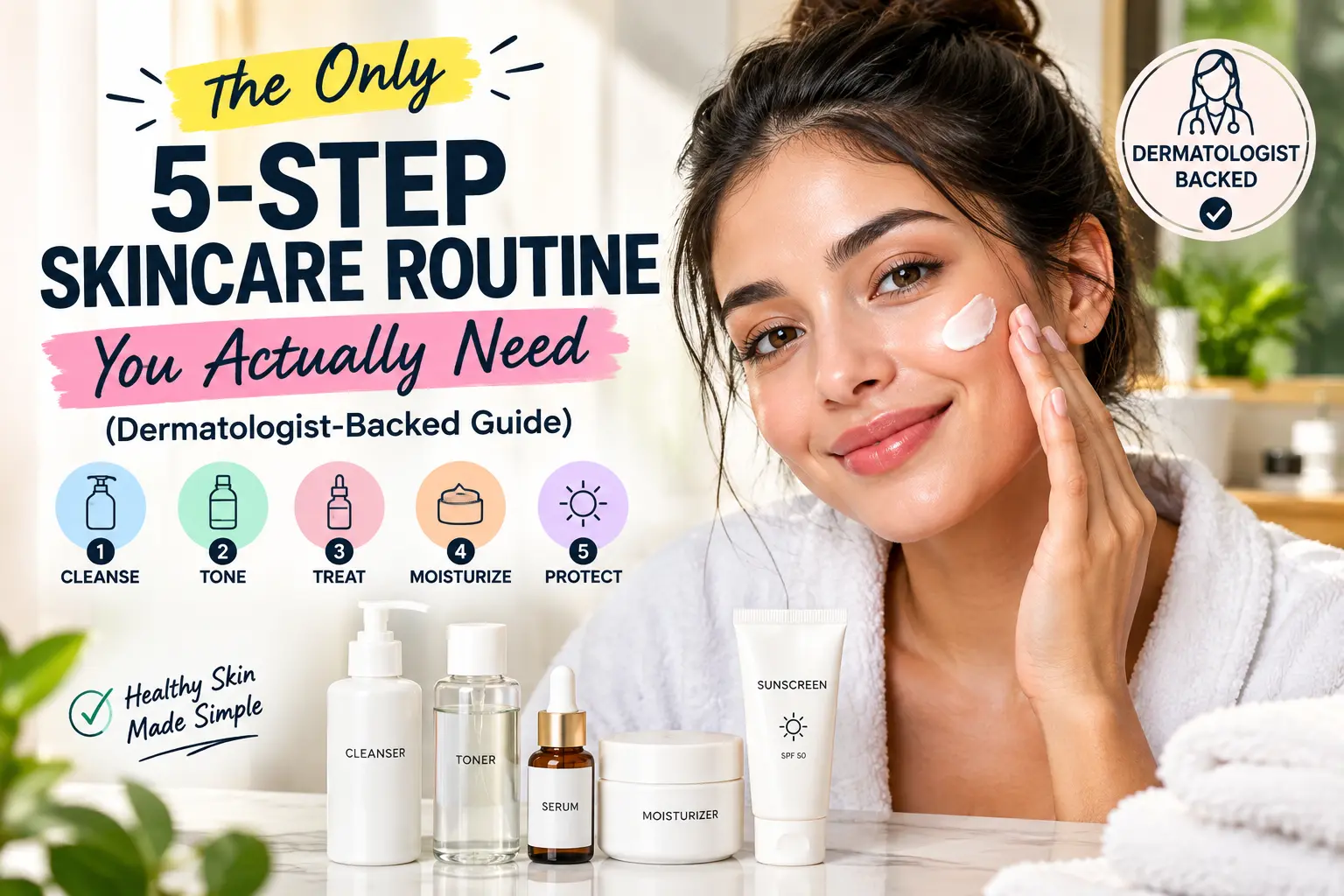
If your bathroom shelf looks like a mini pharmacy stacked with a dozen half-used serums, toners, and mystery creams, you are not alone — and you are not doing your skin any favors.
The beauty industry has convinced millions of people that more products equal better skin. The truth, backed by dermatologists and skincare scientists alike, is the exact opposite.
Your skin does not need twelve steps. It needs five consistent, correctly-sequenced steps, performed with the right ingredients, at the right time, every single day.
This guide will walk you through the only 5-step skincare routine you actually need — a routine so effective and so sustainable that you will never feel tempted to buy another unnecessary product again.
We will cover not just what to do, but why each step matters, when to do it, and how to customize it for your unique skin type.
By the end of this article, you will have a complete, science-backed blueprint for skin that looks calm, clear, and radiant — without the overwhelm, without the wasted money, and without the 45-minute nightly ritual.
Let’s get into it.
Why Most Skincare Routines Fail
Before we dive into the five steps, it’s worth understanding why so many people struggle with their skin despite spending hundreds of dollars a month on products. The most common mistakes include:
- Over-exfoliating, which strips the skin barrier and leads to redness, sensitivity, and breakouts
- Layering too many active ingredients (like retinol, vitamin C, and acids) at once, which causes irritation instead of results
- Skipping sunscreen, which undoes 90% of the good work done by every other product
- Inconsistency — using a routine for three days, seeing no results, and abandoning it
- Chasing trends instead of understanding their own skin type and its actual needs
The routine below solves all five of these problems by focusing on the fundamentals that every dermatologist agrees on, rather than the latest 14-step Korean skincare trend or a viral TikTok hack.
The 5-Step Skincare Routine You Actually Need
Step 1: Cleanse — The Non-Negotiable Foundation
Cleansing is the single most foundational step in any skincare routine, and it is also the step people get wrong most often. The goal of cleansing is simple: remove dirt, oil, sweat, sunscreen, and makeup without stripping your skin’s natural moisture barrier.
Morning cleansing should be gentle — your skin doesn’t need a deep clean first thing in the morning since it hasn’t accumulated much overnight. A gentle, low-pH, sulfate-free cleanser is ideal here. Simply massage it in for 30-60 seconds and rinse with lukewarm (never hot) water.
Evening cleansing is where the real work happens. If you wear sunscreen, makeup, or have been outside all day, consider double cleansing:
- First cleanse with an oil-based or balm cleanser to dissolve sunscreen, makeup, and sebum
- Second cleanse with your regular gentle, water-based cleanser to clean the skin itself
Key ingredients to look for:
- Ceramides — help maintain the skin barrier while cleansing
- Glycerin — a humectant that prevents the cleanser from drying out your skin
- Amino acid-based surfactants — gentle enough for daily use without disrupting your skin’s pH balance
What to avoid: Harsh sulfates (like SLS), and anything that leaves your skin feeling “squeaky clean” — that tightness is a sign your barrier has been stripped, not that your skin is truly clean.
Step 2: Tone (or Treat with Essence) — Prepping the Canvas
The word “toner” has an outdated reputation thanks to the astringent, alcohol-based products of the 1990s that dried out the skin.
Modern toners and essences serve a completely different purpose: they rebalance the skin’s pH after cleansing and deliver a first layer of hydration and active ingredients.
This step is optional for some skin types but highly recommended for most, especially if you experience:
- Dullness or uneven texture
- Enlarged pores
- Dehydration (different from dryness — dehydration is a lack of water, not oil)
What to look for in a toner or essence:
- Hyaluronic acid — attracts and holds water in the skin, plumping it instantly
- Niacinamide — reduces the appearance of pores, evens skin tone, and strengthens the barrier
- Centella asiatica (Cica) — calms inflammation and redness, ideal for sensitive or reactive skin
Apply your toner with clean hands (patting is gentler than using a cotton pad, which can create micro-friction) immediately after cleansing while your skin is still slightly damp — this helps lock in more moisture.
Step 3: Treat — Where Real Transformation Happens
This is the step where you address your specific skin concerns — whether that’s acne, hyperpigmentation, fine lines, dullness, or uneven texture.
This is also the step where less is more. Using one well-chosen treatment consistently will outperform five different serums used sporadically.
Choose based on your primary concern:
For anti-aging and fine lines:
- Retinol or retinoids — the single most research-backed ingredient for reducing fine lines, boosting collagen production, and improving overall skin texture. Start with a low concentration 2-3 times per week and build tolerance slowly.
For dark spots and uneven tone:
- Vitamin C (L-ascorbic acid) — a powerful antioxidant that brightens skin and protects against environmental damage. Best used in the morning under sunscreen.
- Alpha arbutin or tranexamic acid — gentler alternatives that target hyperpigmentation without irritation.
For acne and congested pores:
- Salicylic acid (BHA) — oil-soluble, so it penetrates deep into pores to clear out excess sebum and dead skin cells.
- Benzoyl peroxide — effective for active breakouts, though it should be used strategically to avoid dryness.
For dehydration and dullness:
- Hyaluronic acid serum — layered under moisturizer for a hydration boost.
- Peptides — support the skin’s natural repair processes and improve firmness over time.
The golden rule of this step: Never combine retinol with vitamin C or strong acids in the same routine unless you know your skin can tolerate it.
Alternate them — for example, vitamin C in the morning, retinol at night — to avoid irritation while still getting the benefits of both.
Step 4: Moisturize — Sealing In Everything You Just Applied
No matter your skin type — yes, even oily and acne-prone skin — moisturizer is essential. Skipping this step because your skin feels oily often backfires: when the skin senses dehydration, it can overproduce oil to compensate, making acne and shine worse, not better.
Choose your moisturizer based on skin type:
- Dry skin: Rich, cream-based formulas with ceramides, shea butter, and squalane
- Oily/acne-prone skin: Lightweight, oil-free, gel-based moisturizers with hyaluronic acid and niacinamide
- Combination skin: A medium-weight lotion, potentially layering a richer cream only on drier areas like the cheeks
- Sensitive skin: Fragrance-free formulas with colloidal oatmeal, centella asiatica, or panthenol
Moisturizer does more than just feel nice — it reinforces the skin barrier, locks in the active ingredients you applied in the previous step, and prevents transepidermal water loss (TEWL), which is one of the leading causes of premature aging.
Step 5: Protect — The Step That Makes Every Other Step Worth It
If you only take away one thing from this entire guide, let it be this: sunscreen is the most important anti-aging product that exists. Dermatologists consistently agree that up to 90% of visible skin aging — wrinkles, dark spots, sagging, and uneven texture — is caused by UV exposure, not the natural aging process.
What to look for in a daily sunscreen:
- Broad-spectrum protection (blocks both UVA and UVB rays)
- SPF 30 or higher for daily wear; SPF 50 for prolonged outdoor exposure
- A texture you genuinely enjoy wearing — the best sunscreen is the one you’ll actually reapply
Mineral (zinc oxide, titanium dioxide) vs. chemical sunscreens: Both are effective and dermatologist-approved. Mineral sunscreens tend to suit sensitive skin better, while chemical sunscreens often feel lighter and blend more easily under makeup.
A crucial reminder: Sunscreen should be applied every single day, rain or shine, indoors or outdoors — UVA rays penetrate windows and clouds. Reapply every two hours if you’re outside for extended periods.
Sample Routine: Morning vs. Evening
Morning Routine:
- Gentle cleanser
- Hydrating toner/essence
- Vitamin C serum (antioxidant protection)
- Lightweight moisturizer
- Broad-spectrum SPF 30+
Evening Routine:
- Double cleanse (if wearing makeup/sunscreen)
- Balancing toner/essence
- Treatment serum (retinol, exfoliating acid, or targeted treatment — alternated by night)
- Richer night moisturizer
- (No sunscreen needed at night — this is where your skin repairs itself)
How Long Until You See Results?
Patience is the most underrated skincare ingredient. Here’s a realistic timeline:
- Weeks 1-2: Skin texture and hydration begin to improve
- Weeks 4-6: Breakouts start to calm down; dullness reduces
- Weeks 8-12: Fine lines, dark spots, and overall tone show visible improvement
- 3-6 months: Full results from consistent use of active ingredients like retinol and vitamin C
Consistency beats intensity every time. A simple 5-step routine followed daily for three months will always outperform an elaborate 10-step routine followed sporadically for two weeks.
Common Mistakes That Sabotage Even the Best Routine
- Switching products too frequently — give a new product at least 6-8 weeks before judging its effectiveness
- Using hot water to cleanse — it strips natural oils and can worsen sensitivity
- Applying too much product — a pea-sized amount of most treatments is sufficient; more does not mean better
- Forgetting the neck and hands — these areas age just as fast as the face and deserve the same care
- Picking at skin or over-exfoliating — both delay healing and can cause scarring
Frequently Asked Questions
Do I really only need 5 steps?
Yes. Dermatologists widely agree that cleansing, toning, treating, moisturizing, and sun protection cover every essential function your skin needs.
Additional products (masks, eye creams, exfoliants) can be layered in occasionally, but they are supplements, not necessities.
What if I have sensitive skin?
Simplify further where needed — a gentle cleanser, a soothing essence, a barrier-repairing moisturizer, and mineral sunscreen may be enough while your skin’s tolerance builds.
Can men use this same routine?
Absolutely. Skin physiology does not differ by gender in any way that changes these fundamentals — the same five steps apply universally.
Is expensive skincare better than drugstore skincare?
Not necessarily. Formulation and active ingredient concentration matter far more than price or branding. Many effective, dermatologist-recommended products are available at accessible price points.
Final Thoughts: Less, But Better
The only 5-step skincare routine you actually need proves a simple but powerful truth: skincare success isn’t about how many products you own — it’s about how consistently and correctly you use the right ones.
Cleanse, tone, treat, moisturize, and protect. Master these five steps, and your skin will thank you for years to come.