

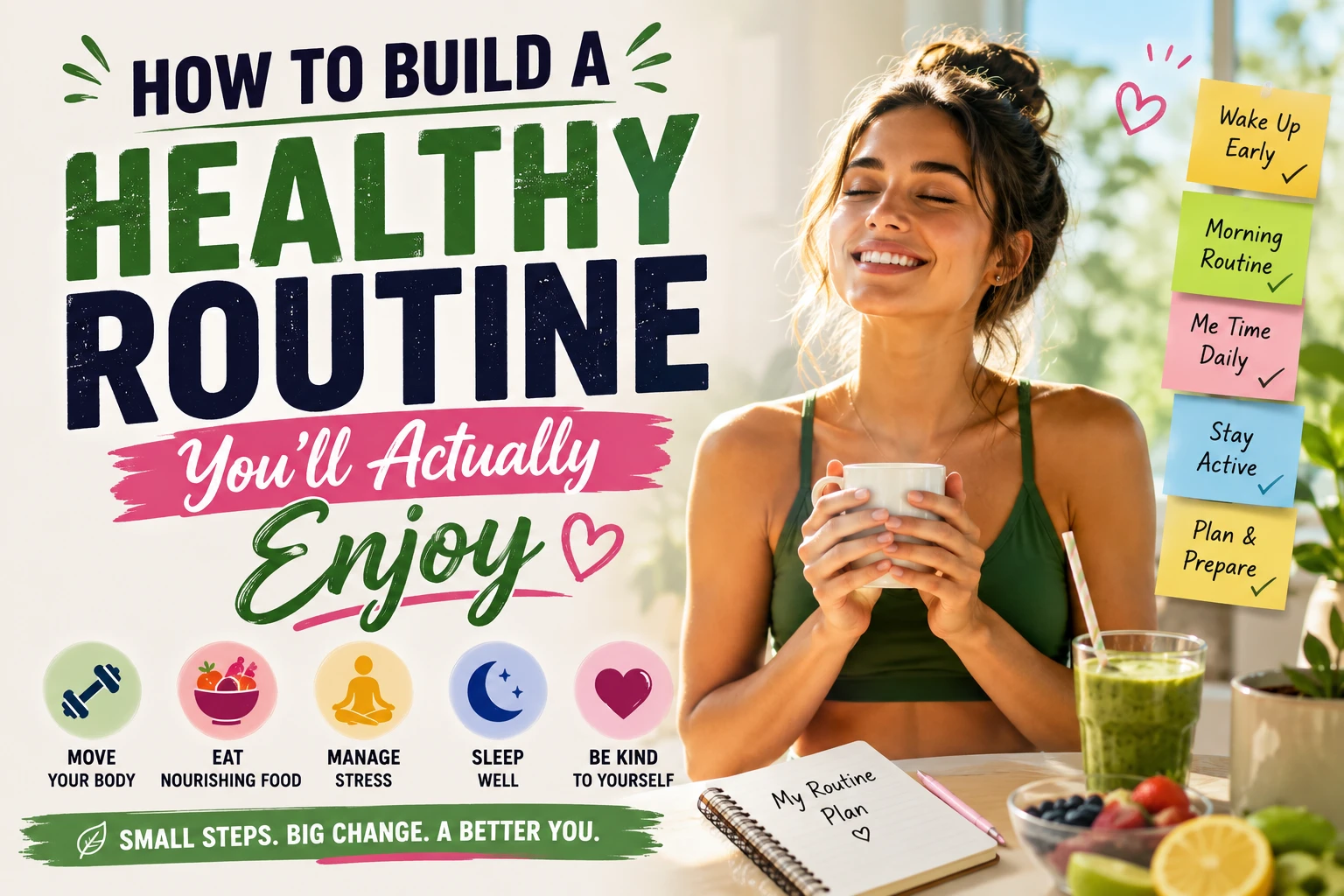
If you’ve ever downloaded a habit tracker app, bought a fresh planner, or promised yourself “this is the year I finally get healthy,” only to abandon the whole plan by week three — you are not alone, and more importantly, you are not the problem. The routine was.
Most advice on building healthy habits treats humans like machines: input discipline, output results. But motivation is not a reliable fuel source. It flickers.
It disappears exactly when you need it most — on a rainy Monday, after a bad night’s sleep, in the middle of a stressful week at work. If your entire routine depends on willpower, it is, by design, temporary.
This article takes a different approach. Instead of telling you to “just be more disciplined,” we’re going to walk through exactly how to design a routine around your actual life, personality, and energy levels — one that survives bad days, doesn’t require heroic self-control, and that you genuinely look forward to.
This isn’t about perfection. It’s about building something sustainable enough to still be standing a year from now.
1. Why Willpower Alone Always Fails
Here’s an uncomfortable truth: willpower is a finite, fluctuating resource, not a personality trait. Research in behavioral psychology has repeatedly shown that self-control depletes throughout the day, much like a muscle that tires from overuse. This is sometimes referred to as decision fatigue.
That’s why you can wake up on Monday morning with the best intentions to eat clean, exercise, meditate, and go to bed early — and by Wednesday evening, after a long day of decisions at work, you’re ordering takeout and scrolling your phone until 1 a.m.
This isn’t a failure of character. It’s a failure of design. A routine that leans entirely on motivation and willpower is a routine built on sand. The goal, instead, is to build a routine that requires less willpower over time, not more.
2. The Psychology of Habits That Actually Stick
Every durable habit follows a predictable loop, often broken into three parts:
- Cue — the trigger that initiates the behavior (a time of day, a location, an emotional state)
- Routine — the behavior itself
- Reward — the payoff that tells your brain “do this again”
Most people focus obsessively on the routine part — the workout, the meal prep, the meditation session — while completely ignoring the cue and reward. This is like trying to start a car by pushing on the gas pedal without ever turning the key.
To build something that lasts, you need to engineer all three parts of the loop, not just the middle one. We’ll come back to this framework throughout the article.
3. Step 1: Start With Identity, Not Outcomes
Most people set goals like “I want to lose 10 pounds” or “I want to run a marathon.” These are outcome-based goals, and while they’re not inherently bad, they are a weak foundation for a routine because they’re temporary and externally focused. Once the outcome is achieved (or abandoned), the motivation disappears with it.
A far more powerful approach is identity-based habit building — deciding who you want to become, and then taking small actions that are consistent with that identity.
- Instead of “I want to lose weight,” try: “I am someone who moves their body every day.”
- Instead of “I want to eat healthier,” try: “I am someone who nourishes their body with real food.”
- Instead of “I want to read more,” try: “I am someone who prioritizes learning.”
Every time you complete a small action tied to this identity, you’re casting a vote for the person you’re becoming. Over time, these votes accumulate into genuine, internalized change — the kind that doesn’t require a countdown timer or a finish line to sustain.
4. Step 2: Audit Your Current Life Before Adding Anything New
One of the biggest mistakes people make is bolting a brand-new routine onto an already overloaded life. Before adding anything, take an honest inventory:
- What does a typical weekday actually look like, hour by hour?
- Where are your natural pockets of time and energy?
- What currently drains you — and what currently energizes you?
- Which existing habits are already working, even small ones?
This audit matters because a routine that ignores your real schedule is a routine designed to fail. If you’re not a morning person, building a 5 a.m. routine around intense willpower is setting yourself up for disappointment. Work with your natural rhythms, not against them.
5. Step 3: Choose “Keystone Habits” That Create a Ripple Effect
Not all habits carry equal weight. Keystone habits are specific behaviors that naturally trigger positive changes in other areas of your life without you having to consciously manage them.
Common examples include:
- Consistent sleep and wake times — improves energy, appetite regulation, mood, and decision-making
- Regular movement — often naturally improves diet, sleep, and stress levels
- Meal planning — reduces decision fatigue and impulsive food choices
- A short morning routine — sets the tone and reduces chaotic, reactive mornings
Rather than trying to overhaul ten areas of your life simultaneously, identify one or two keystone habits and focus your energy there first. The ripple effects will do a surprising amount of the rest of the work for you.
6. Step 4: Make It Absurdly Easy to Start
This is arguably the single most important — and most overlooked — principle in sustainable habit-building: reduce the friction of starting to nearly zero.
Most people fail not because the habit itself is hard, but because the barrier to entry is too high. If “exercise” in your mind means a 90-minute gym session, you will skip it on busy days — and busy days are most days.
Instead, define a minimum viable version of the habit:
- Instead of “workout for an hour,” start with “put on workout clothes and do five minutes.”
- Instead of “meditate for 20 minutes,” start with “take three deep breaths.”
- Instead of “read a book every night,” start with “read one page.”
This might sound too small to matter — but that’s precisely the point. Showing up consistently, even minimally, builds the identity and the neural pathway. You can always do more once you’ve started; most days, once you begin, momentum carries you further than the minimum. But even on the days it doesn’t, the streak stays alive.
7. Step 5: Stack New Habits Onto Existing Ones
Habit stacking is a technique where you attach a new, small behavior to an existing, well-established one, using the old habit as the cue for the new one. The formula looks like this:
“After I [existing habit], I will [new habit].”
Examples:
- “After I pour my morning coffee, I will write down three things I’m grateful for.”
- “After I brush my teeth at night, I will lay out my clothes for tomorrow.”
- “After I sit down at my desk, I will drink a full glass of water.”
Because the existing habit is already automatic, it acts as a reliable, built-in reminder — you don’t need to rely on memory or motivation to trigger the new behavior. This is one of the most efficient ways to embed new habits into a life that’s already full.
8. Step 6: Design for Bad Days, Not Just Good Ones
Here’s something most routine-building advice completely ignores: your routine will be tested most on the days you feel least capable of following it. A truly sustainable routine has a built-in “bad day” version.
Create a minimum non-negotiable version of each core habit for rough days:
| Habit | Ideal Day Version | Bad Day Version |
|---|---|---|
| Exercise | 45-minute workout | 5-minute stretch or short walk |
| Nutrition | Home-cooked balanced meals | One vegetable added to whatever you eat |
| Mindfulness | 15-minute meditation | Three slow breaths |
| Sleep | Full wind-down routine | Phone away 10 minutes before bed |
The goal isn’t to lower your standards — it’s to protect the habit’s continuity. Missing a day entirely breaks the chain and makes it psychologically easier to miss the next one. A tiny, imperfect version keeps the identity and momentum alive.
9. Step 7: Build In Rewards That Aren’t Sabotage
Remember the habit loop from earlier — cue, routine, reward? The reward is often the missing piece. Without a genuine payoff, your brain has little reason to repeat the behavior.
The trap many people fall into is choosing rewards that undo the very habit they just built — like rewarding a workout with a large dessert, or “treating yourself” after a productive week by abandoning the routine entirely.
Instead, look for rewards that reinforce rather than cancel out your progress:
- A favorite playlist or podcast reserved only for workout time
- A relaxing bath or a favorite show after a week of consistent sleep habits
- Tracking a visible streak, which creates its own small dopamine hit
- Simply pausing to acknowledge, out loud, “I did the thing I said I would do”
Small, consistent rewards — especially ones tied to the identity you’re building — are far more powerful than occasional large ones.
10. Step 8: Track Progress Without Becoming Obsessive
Tracking can be a powerful motivator, but it can also backfire if it becomes another source of pressure or perfectionism. The healthiest approach is tracking consistency, not perfection.
A few effective, low-stress methods:
- Habit trackers with simple checkmarks — visual proof of consistency builds motivation
- Weekly reviews instead of daily judgment — ask “how did this week go overall?” rather than obsessing over each day
- The “don’t break the chain twice” rule — missing one day is human; missing two in a row is where habits quietly die, so treat that as your real red flag
Remember: the goal of tracking is awareness and encouragement, not another way to criticize yourself.
11. A Sample Weekly Routine Framework
Here is a flexible, realistic framework you can adapt — not a rigid prescription, but a starting structure:
Mornings (10–20 minutes):
- Hydrate immediately upon waking
- Brief movement or stretching
- One intentional, screen-free moment (journaling, gratitude, or quiet coffee)
Throughout the day:
- One balanced, unhurried meal
- A short walk or movement break, especially after long periods of sitting
- One moment of genuine connection — a message, call, or conversation
Evenings (15–30 minutes):
- A wind-down cue (dim lights, put the phone away, light stretching)
- Prepare for tomorrow (clothes, food, priorities) to reduce morning decision fatigue
- Consistent sleep and wake time, even on weekends
This is intentionally light. A sustainable routine should feel spacious, not suffocating.
12. Common Mistakes That Quietly Kill Routines
- Trying to change everything at once — overwhelms your capacity for willpower and attention
- Copying someone else’s routine exactly — what works for a content creator’s curated morning may not fit your actual life or chronotype
- All-or-nothing thinking — treating one missed day as total failure
- No clear cue — habits without a trigger rely entirely on memory and motivation, both unreliable
- Ignoring energy levels — scheduling demanding habits during your lowest-energy hours of the day
- No flexibility built in — a routine so rigid that one disruption (travel, illness, a busy week) collapses the entire system
13. How to Recover After You Fall Off Track
Every single person who has ever built a lasting healthy routine has also fallen off it at some point — illness, travel, a stressful season of life, burnout. This is not a sign of failure; it’s a universal part of the process.
The way you recover matters far more than the fact that you slipped. A few principles:
- Don’t wait for “Monday” or “next month.” The best time to restart is the very next opportunity, not an arbitrary calendar milestone.
- Restart with the minimum viable version, not the full intensity — this rebuilds momentum without triggering overwhelm.
- Get curious, not critical. Ask what specifically disrupted the routine, and whether the routine itself needs adjusting.
- Expect the wobble. Building any new identity involves setbacks; anticipating them removes their power to derail you completely.
14. Final Thoughts: Consistency Over Intensity
A healthy routine you’ll actually enjoy isn’t the one that looks most impressive on paper, and it isn’t the one that demands the most discipline. It’s the one that’s built around who you really are — your energy patterns, your schedule, your preferences, and the identity you’re quietly trying to grow into.
Small, consistent, enjoyable actions — repeated over months and years — will always outperform an intense routine that burns out in three weeks. Start small. Design for your bad days, not just your best ones. Build in real rewards. And give yourself permission to fall off track sometimes, because the ability to get back on is the actual skill you’re building.
The healthiest routine isn’t the perfect one. It’s the one you’re still doing a year from now.